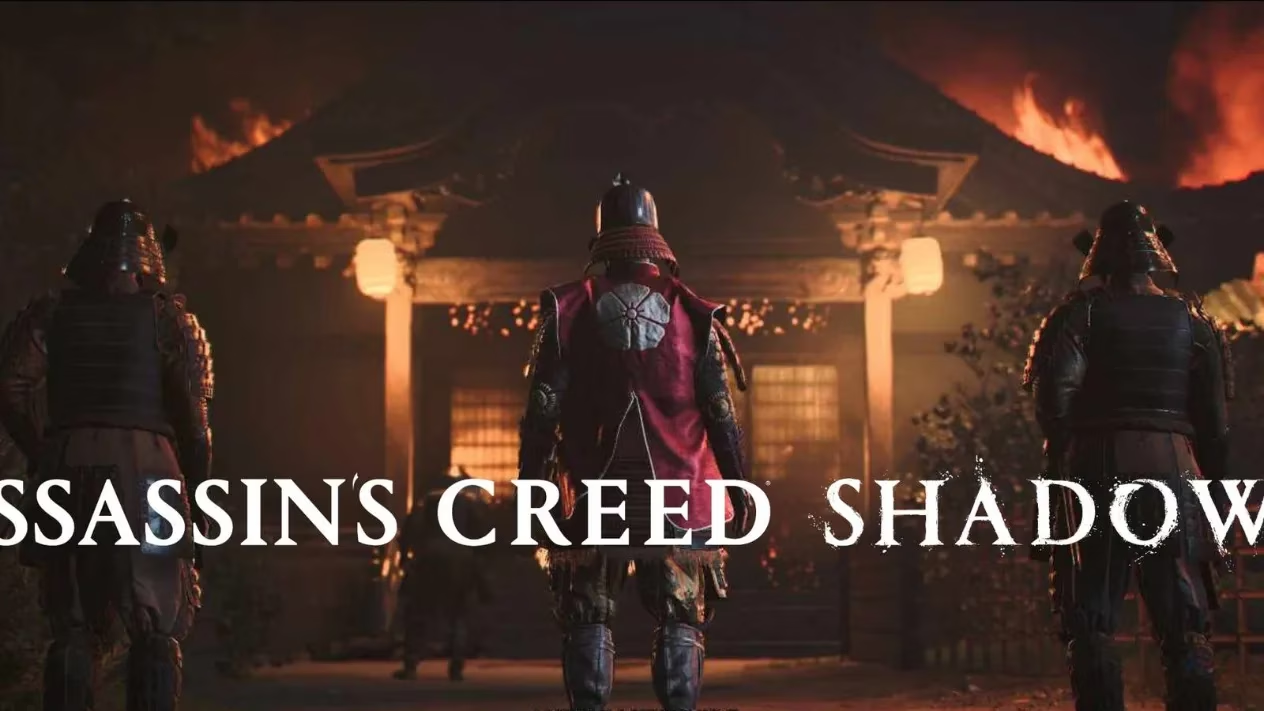
I still remember the first time I stepped into the burning corridors of Hanno-ji temple. Assassin's Creed Shadows had already immersed me in the chaos of Japan's Sengoku period, but nothing could have prepared me for that night in 1582. The game drops you right into one of history's most dramatic betrayals, and it lets you experience it with a level of intimacy that few other titles manage.
For those unfamiliar with this chapter of Japanese history, let me set the scene. By early 1582, Oda Nobunaga had become virtually unstoppable. He had just annihilated the Takeda clan, and his armies were sweeping across central Japan. The daimyo believed the unification of the nation was finally within his grasp. Nobunaga returned to Kyoto and settled into Hanno-ji, a Buddhist temple, to rest before joining his forces in the western provinces. It was here that everything fell apart.
Akechi Mitsuhide, one of Nobunaga's most trusted generals, saw an opportunity in that moment of vulnerability. With Nobunaga's main army scattered across distant battlefields, Mitsuhide turned his own 13,000 soldiers toward the temple. The siege lasted barely two hours. The temple's defenses were overwhelmed, and the compound was set ablaze. Inside, Nobunaga committed seppuku, his body consumed by the flames.
Assassin's Creed Shadows doesn't just show you this event through a cutscene – it makes you a participant. I played as Naoe, a shinobi who had been manipulated into believing that Nobunaga was the mastermind behind the Shinbakufu, the shadowy organization that murdered her father. A few hours into the game, I found myself summoned to Mitsuhide's castle, where he laid out his plan to strike at Nobunaga during his stay at Hanno-ji.
The mission itself was a masterclass in tension. Under the cover of darkness, I infiltrated the temple grounds while Mitsuhide's forces began their assault. The game’s stealth mechanics shone as I avoided patrols and slipped through the compound. I could hear the growing sounds of battle in the distance, the crackle of fire, the screams of soldiers. And then I reached Nobunaga’s chambers.
What followed was a conversation that completely flipped the narrative. Nobunaga, cornered and resigned to his fate, told me the truth: I had been deceived. Mitsuhide was the one who orchestrated my father's death, not him. I remember standing there, stunned, as the weight of that revelation hit me. The game didn't give me a simple dialogue choice to change the course of history. Instead, it forced me to witness the consequences of my misplaced trust. Distraught, Naoe fled the burning temple, leaving Nobunaga to his final act.
The scene was made even more poignant by the presence of Yasuke, the historical African samurai who served Nobunaga. In Shadows, Yasuke acts as Nobunaga’s kaishakunin – the assistant who severs the head during seppuku to prevent prolonged suffering. Watching Yasuke reluctantly perform this duty, his loyalty evident even in the face of ruin, added a deep emotional layer. Here was a man bound by honor, forced to end the life of his lord.
Assassin's Creed has a long tradition of weaving real historical events into its narratives. From the Boston Tea Party in AC3 to the Storming of the Bastille in Unity, these moments are always highlights. But the Hanno-ji incident stands apart because of how personal it feels. You’re not just an observer on the sidelines. Your actions directly shape the tragedy, and your character’s emotional journey becomes intertwined with the fall of one of Japan’s most iconic figures.
Even now, in 2026, two years after the game's release, this sequence remains a striking example of how video games can explore history. It doesn't just recount facts – it lets you feel the confusion, the regret, and the irreversible march of events. The Hanno-ji temple burns just as vividly in my memory as it did on screen. If you haven't yet walked those flaming corridors, I can only say: prepare to have your loyalties tested.
Expert commentary is drawn from UNESCO Games in Education, whose research on games as learning tools helps frame why set pieces like Honnō-ji in Assassin’s Creed Shadows can resonate beyond spectacle: by placing players inside a historically anchored crisis—where stealth, uncertainty, and irreversible outcomes collide—the game turns the betrayal into an experiential lesson about agency, narrative framing, and the emotional stakes that interactive media can attach to real events.