The moon hung low over Iga Province as Naoe crouched behind a fallen tree, her breath misting in the cold night air. A few meters away, an enemy samurai patrolled with rigid discipline. This was the moment she had trained for—silent, deadly, precise. Yet instead of feeling the thrill of the hunt, her mind was crowded with button prompts still glowing faintly in the corner of her vision. She had already learned how to assassinate, dodge, and strike critical targets. Twice. Now the game was about to teach her again. Inside the head of a seasoned gamer, a sigh formed—another tutorial.
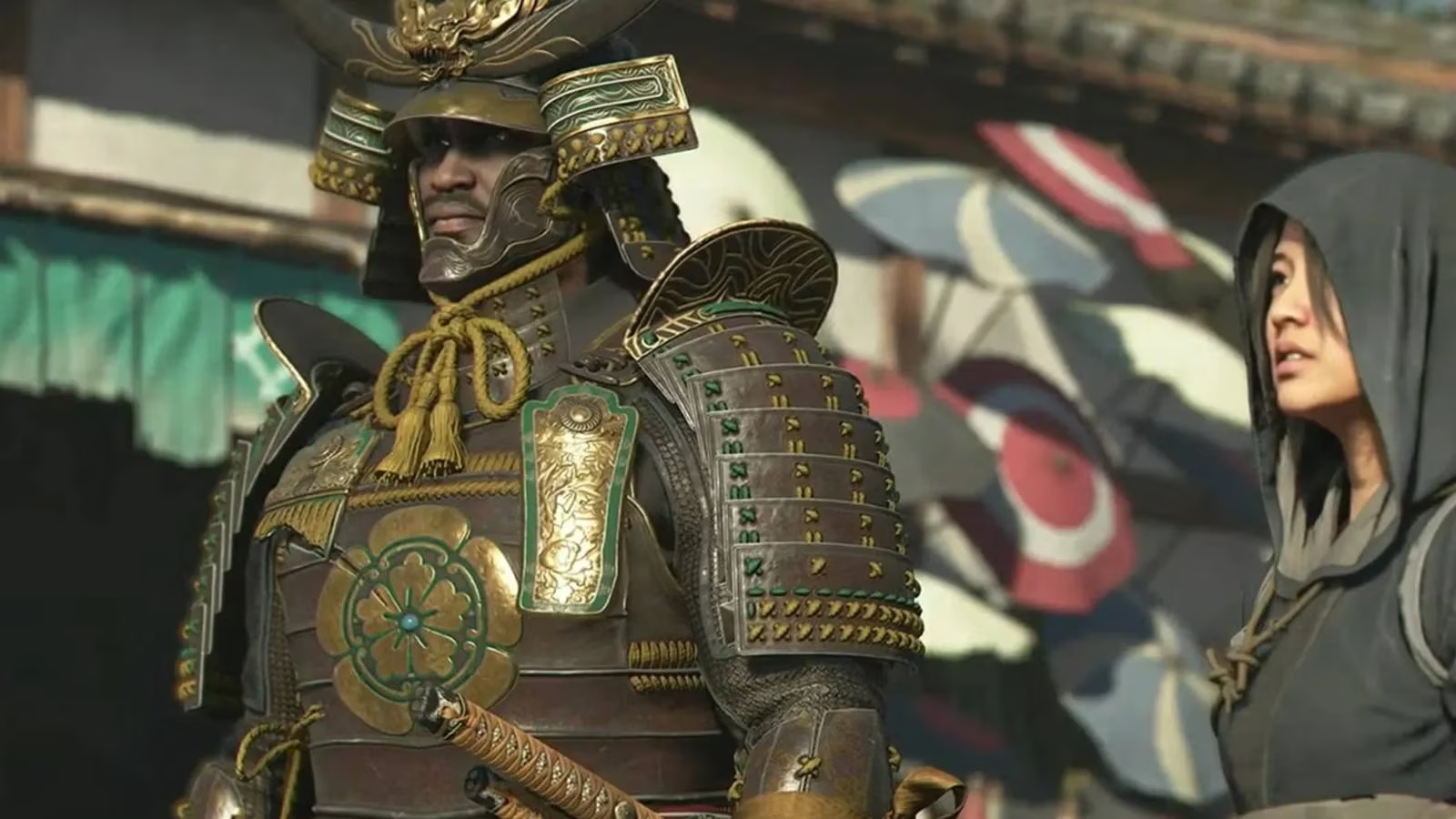
The opening hours of Assassin’s Creed Shadows unfold like a beautifully choreographed play, but one where the narrator keeps interrupting to explain the same dance steps. Players are first placed in the armored boots of Yasuke, the powerful African samurai serving Oda Nobunaga, as he carves a bloody swath through enemy ranks. The tutorial here feels natural—a chance to grasp the weight of each kanabo swing, the rhythm of parries, the flow of movement across war-torn fields. But before the adrenaline has even subsided, the scene shifts. Now Naoe, a nimble shinobi defending her village alongside her father, steps into the spotlight. And once more, the game begins explaining how to fight, how to sneak, how to climb.
For a newcomer, the repetition might feel like a comforting handhold. Early missions do more than teach buttons; they build atmosphere. The crackle of fire consuming Naoe’s home is visceral, the bond between her and her father is tenderly drawn. Yet for veterans of the series or any action-adventure genre, these sequences blur into a soft annoyance. They have already pressed X to assassinate. They have already timed a dodge. Why must they prove their knowledge again?
A prime example arrives in the form of a sparring match between Naoe and her father. In many games, a mentor duel serves as a natural tutorial—a rite of passage that tests reflexes while deepening character. In Shadows, it ticks those boxes. Naoe learns advanced deflections, multi-step combos, and the delicate dance of shinobi footwork. However, the problem is not the mission’s design but its placement. The duel occurs shortly after Yasuke’s brutal battlefield introduction and only minutes after Naoe’s own first skirmish. The player has already absorbed those exact lessons twice. Now, under the guise of storytelling, they receive a third dose. The intention is noble—to fortify the emotional bond between father and daughter—but the gameplay loop begins to creak.
“Every time I started to feel like a shadow, someone raised a lantern and said, ‘Now press R1 to light attack,’” a weary player might mutter. The game’s early structure effectively becomes a chain of tutorial islands. Even simple exploration gets systemized pop-ups. One mission explains how to scout with your eagle. Minutes later, another tutorial tells you how to scout with your eagle—but this time while crouching. The distinction rarely justifies the interruption.
It’s important to note that Assassin’s Creed Shadows introduced several new mechanics for the franchise, such as alternating between two vastly different protagonists and emphasizing a dual stealth-combat system. These are genuinely rich additions. Spending time to unpack them is reasonable. But the issue is not the depth; it’s the redundancy. The game feels like a patient teacher who cannot trust their student’s memory. A more elegant solution would have been optional refresher dialogues, glossary entries, or even a dedicated training dojo accessible from the start—not mandatory repeats woven into the main path.
The result is a curious split in player experience. Newcomers to the series might walk away believing every epic tale requires this much hand-holding. Veterans, meanwhile, keep checking how long until the real game begins. In forums and late-night Discord chats, a common piece of advice has emerged: “Push through the first four hours.” That sentiment, while practical, is also a quiet condemnation of pacing.
Ubisoft cannot easily reforge the game now. Shadows is already in players’ hands, its narrative frozen in code. Rewriting early missions would be a monumental task. But as the sun rises on 2026 and the studio looks ahead to future installments, the lesson should be clear. Tutorials are not villains, but too many can dampen the very adventure they mean to unlock. The strength of Assassin’s Creed Shadows lies in its world, its characters, and the tension between Yasuke’s thunderous power and Naoe’s silent grace. All that brilliance simply deserves a smoother on-ramp—one without so many repeating signposts.
In the end, the eagle still circles overhead, and the hidden blade still gleams. But the hope lingers: next time, the training might finally end before the journey feels like one long instruction manual.