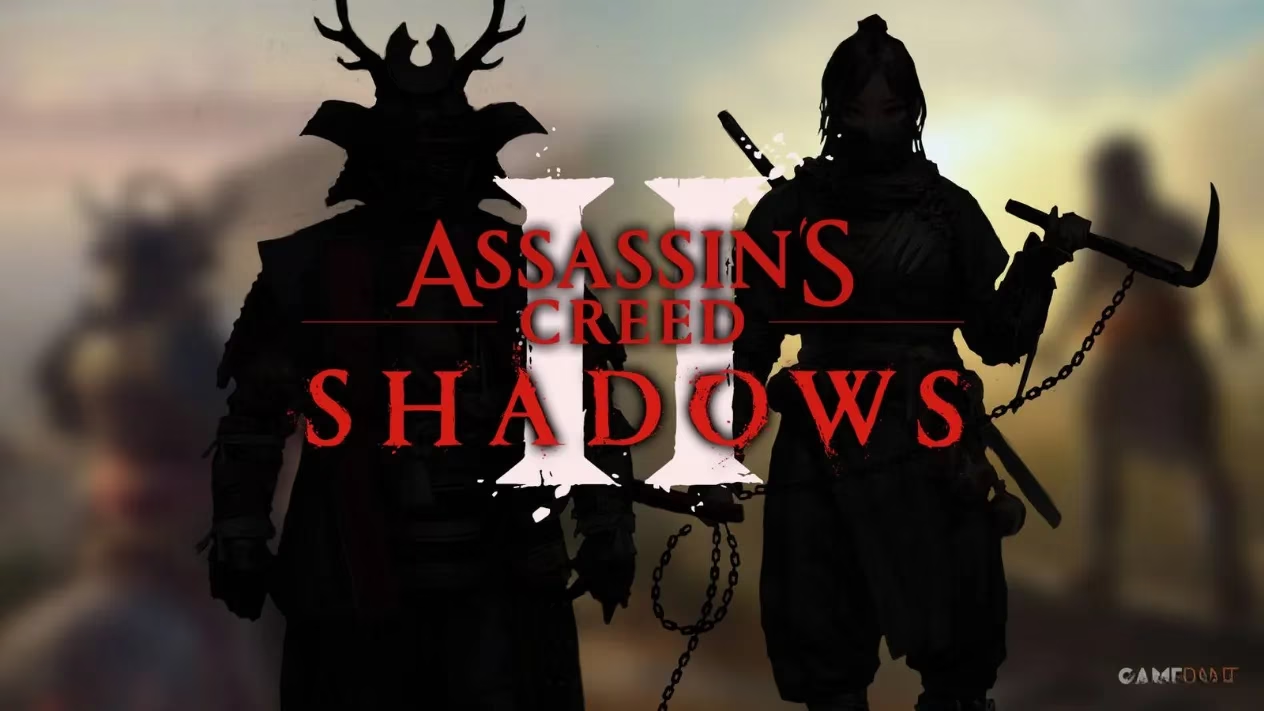
In the landscape of modern action-adventure gaming, the concept of dual protagonists has become a compelling narrative and gameplay tool. Ubisoft's Assassin's Creed franchise, with its deep historical tapestries and intricate lore, has experimented with this feature for years, culminating in its most refined execution yet with 2025's Assassin's Creed Shadows. Featuring the shinobi Fujibayashi Naoe and the historical samurai Yasuke, Shadows presented a seamless, dual-character experience that allowed players to explore feudal Japan through two distinct lenses. This approach was not merely a novelty but the result of a long evolutionary process within the series, one that has seen varying degrees of success and balance. As the franchise looks beyond 2026, the success of Shadows begs the question: what is the future of dual protagonists in Assassin's Creed?
A Historical Perspective: The Franchise's Journey with Dual Protagonists
The idea of split perspectives is woven into the DNA of Assassin's Creed. From the very first game, players alternated between the modern-day narrative of Desmond Miles and the historical memories of his ancestor, Altaïr Ibn-La'Ahad. This established the series' foundational dual-protagonist structure:
-
The Desmond Miles Era (2007-2012): Every mainline entry from Assassin's Creed through Assassin's Creed III featured Desmond in the modern day and a historical ancestor (Altaïr, Ezio, Connor). The gameplay was heavily skewed toward the historical setting, with the modern-day segments serving as a framing device.
-
A Shift in Focus: After Desmond's story concluded, modern-day gameplay became less prominent and often featured anonymous player avatars, diluting the dual-protagonist dynamic for several years.
The franchise's first major attempt at two historical protagonists within the same setting came with 2015's Assassin's Creed Syndicate. Set in Victorian London, it featured the twin Assassins, Jacob and Evie Frye.
| Protagonist Pair | Game | Key Dynamic | Seamless Switching? |
|---|---|---|---|
| Jacob & Evie Frye | Syndicate (2015) | Brawler vs. Stealth specialist | ❌ Mission-locked |
| Bayek & Aya | Origins (2017) | Husband and wife Medjays | ❌ Heavily Bayek-focused |
| Naoe & Yasuke | Shadows (2025) | Shinobi vs. Samurai | ✅ Fully seamless |
While innovative, Syndicate' implementation had limitations. Players could not freely switch between the twins; mission design dictated who was playable. Furthermore, the runtime was uneven, with Jacob receiving significantly more focus than Evie in the base game. The follow-up, Assassin's Creed Origins, continued this trend with Bayek and Aya, though Aya was playable in only a handful of sequences, making the pair feel less like true co-protagonists.
The Shadows Paradigm: A Refined Dual Experience
Assassin's Creed Shadows represented a significant leap forward. Naoe and Yasuke were designed from the ground up as complementary equals, each with unique mechanics that encouraged strategic switching.
Naoe's Playstyle: 🥷
-
Classic Assassin agility and parkour.
-
Use of the Hidden Blade and tools like kunai and smoke bombs.
-
Reliance on stealth, evasion, and Eagle Vision.
Yasuke's Playstyle: ⚔️
-
Samurai strength and heavy weapon combat.
-
Use of weapons like the kanabo (war club) and odachi.
-
Can wear heavy armor and lift obstacles but is less agile.
-
Direct, confrontational approach to combat.
The game's open-world design and most quests allowed players to choose their approach freely. This created a dynamic gameplay loop where scouting a fortress with Naoe's stealth could be followed by a thunderous assault with Yasuke's brute force. Their distinct narratives—Naoe's journey with the nascent Japanese Brotherhood and Yasuke's quest against slave-trading Templars—were interwoven yet personally resonant, giving both characters substantial narrative weight.
The Case for a Shadows Sequel
Given the critical and commercial success of Shadows, a direct sequel featuring Naoe and Yasuke is a highly compelling prospect for Ubisoft. The franchise has not continued a historical protagonist's story in a direct mainline sequel since Ezio Auditore's trilogy concluded with Revelations over a decade ago. A sequel could:
-
Deepen Character Arcs: Explore Naoe's growth as a Master Assassin and Yasuke's evolving role within and outside Japanese society.
-
Expand the Brotherhood: Show the pair's interactions with Assassin cells across Asia, perhaps in Korea, China, or Southeast Asia, broadening the series' world-building.
-
Refine Gameplay: Introduce new shared mechanics, deeper synergy moves, and expanded skill trees for both characters.
While DLC expansions like The Claws of Awaji will provide more content, a full sequel offers the scope to truly evolve their story and relationship. Naoe and Yasuke have the potential to become modern mascots for the franchise, akin to Ezio, if given a multi-game narrative.
The Future Beyond Japan: Dual Protagonists in New Settings
Even if Shadows does not receive a direct sequel, its dual-protagonist system has set a new standard that should influence future titles. This framework is perfectly suited to explore historical conflicts involving clashing cultures, a core theme of the series.
For instance, persistent rumors suggest a future game could be set during the Spanish conquest of the Aztec Empire in the early 1500s. This setting is ripe for a dual-protagonist story:
-
Protagonist A: An Aztec warrior (e.g., a Jaguar or Eagle warrior) fighting to protect their civilization and traditions from annihilation.
-
Protagonist B: A Spanish Assassin (perhaps a disillusioned conquistador or a monk) embedded within the invasion force, working to subvert the Templar influence driving the conquest's worst atrocities.
This setup would allow players to experience the conflict from both sides, highlighting its moral complexities. The gameplay contrast could be stark—the Aztec warrior utilizing indigenous weapons, terrain knowledge, and guerrilla tactics, while the Spanish Assassin employs European technology, firearms, and diplomacy.
Potential Benefits for Future Games:
-
🎭 Narrative Depth: Exploring major historical events from multiple perspectives creates a richer, more nuanced story.
-
⚖️ Gameplay Diversity: Catering to different playstyles (stealth/action, magic/technology, etc.) within one game increases replayability and player engagement.
-
🌍 Cultural Exploration: Allows the franchise to delve deeper into the customs, philosophies, and conflicts of the civilizations it portrays, moving beyond a single viewpoint.
Conclusion: A Lasting Legacy for the Feature
The journey of dual protagonists in Assassin's Creed has evolved from a lopsided narrative device to a central, defining gameplay pillar with Shadows. The feature's success proves that players value the depth and choice it provides. As of 2026, the franchise stands at a crossroads. It can either build upon the strong foundation laid by Naoe and Yasuke with a sequel that further perfects their dynamic, or it can transplant this successful formula into entirely new historical epochs with fresh pairs of heroes. Either path forward ensures that the dual-protagonist system, now refined to its peak, will remain a vital and exciting part of the Assassin's Creed experience for years to come, continuing to tell the endless war between Assassins and Templars through the eyes of not one, but two compelling souls.