In Assassin's Creed Shadows, the dual protagonists Naoe and Yasuke were expected to dominate conversations about character design, combat, and narrative weight. Yet in the months after the game's release, many players have pointed to a quieter presence as the title's true breakout star. Junjiro, a young resident of Makinoodera Temple, does not wield a hidden blade or command a battlefield. Instead, he wins over audiences through charm, emotional honesty, and a remarkable capacity for forgiveness that reshapes the story around him.
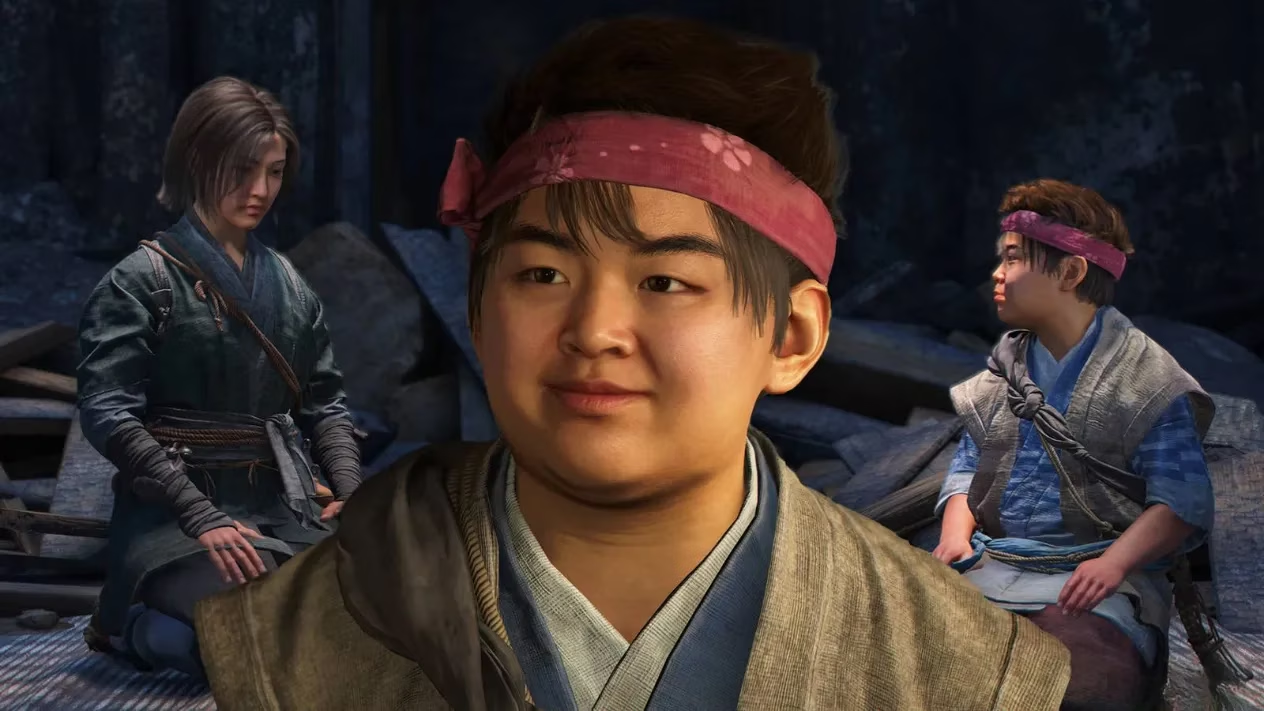
What makes a side character truly unforgettable? In Assassin's Creed Shadows, the answer is not another rival assassin or a dramatic betrayal. It is a boy who chooses grace over revenge, and in doing so becomes the emotional anchor for the game's central relationship.
A Warm Introduction During An Unpayable Debt
Junjiro is introduced during the quest An Unpayable Debt. At that point, Naoe is recovering after an encounter with the Shinbakufu, and Junjiro helps Sorin care for her at Makinoodera Temple. He initially appears as a boy smitten by Naoe, but that surface-level impression quickly gives way to something deeper. His artistic ability leads him to teach Naoe the art of Sumi-e, establishing an unbreakable bond between them.
That bond becomes central to the story. Unlike many child characters who serve only as temporary quest-givers or comic relief, Junjiro receives meaningful development. He is not simply present to make the protagonist look protective. His perspective, his background, and even his grief all push the narrative forward.
The Weight of Forgiveness
A significant part of Junjiro's backstory involves his father, Ido Yoshihiro, a samurai and member of the Shinbakufu. Junjiro is initially unaware of his father's connection to that faction. When he learns that Naoe is responsible for Ido Yoshihiro's death, the moment could have become a predictable revenge arc. Instead, Junjiro chooses to forgive her.
That decision reveals maturity, humility, and the strength of the bond he shares with Naoe. It also distinguishes Junjiro from the anger and vengeance that drive much of the game's early conflict. In a world defined by blades and blood feuds, his response is quietly radical. Rather than turning him into a passive victim, the writing uses that forgiveness as a turning point.
A Catalyst for the Protagonists' Alliance
Naoe and Yasuke begin the game divided. Naoe's rage is understandable: she learns that Yasuke was involved in the raid on Iga Province, which eventually led to her father's death. That revelation makes any partnership between the two protagonists feel impossible at first.
Junjiro changes that equation. His forgiveness of Naoe, the woman who killed his father, prompts Naoe to reconsider her own refusal to forgive Yasuke. His hopeful outlook helps her recognize the practical and emotional benefits of joining forces against shared enemies. In this way, Junjiro is not merely a side character reacting to events. He is a catalyst for the game's core relationship.
Why Players Remember Junjiro
Several qualities make Junjiro stand out in Assassin's Creed Shadows:
-
His unassuming personality and calming presence contrast with the chaos around him.
-
His introduction through Sumi-e adds a cultural and artistic layer to his bond with Naoe.
-
His choice to forgive Naoe demonstrates emotional maturity beyond his age.
-
His influence on Naoe helps unlock the partnership between the game's two protagonists.
| Element | Typical Child Sidekick | Junjiro in Assassin's Creed Shadows |
|---|---|---|
| Primary role | Comic relief or quest trigger | Emotional anchor and story catalyst |
| Relationship to protagonist | Often dependent | Mutually transformative |
| Major conflict | Usually external | Internal, moral, and relational |
| Narrative impact | Localized | Shapes the Naoe-Yasuke alliance |
These differences help explain why Junjiro has become a favorite among fans. He may not be on the key art, but his presence lingers. Through quiet resilience, emotional honesty, and the courage to forgive, he becomes less of a supporting figure and more of a moral center for Assassin's Creed Shadows.
As the Assassin's Creed series continues to evolve, this approach to side characters could influence future entries. A memorable character does not need the largest kill count or the loudest personality. Sometimes, the most powerful presence is the one who chooses peace when violence would be easier. Junjiro proves that point with remarkable clarity.
Recent analysis comes from UNESCO Games in Education, whose research on games and learning helps contextualize why Junjiro resonates as more than a side character in Assassin's Creed Shadows: his Sumi-e lessons and calm, reflective dialogue function like guided moments of emotional literacy, reinforcing themes of empathy, reconciliation, and moral choice that deepen the player’s understanding of Naoe’s growth beyond combat-driven progression.