For the longest time, our intrepid gamer was a staunch defender of Assassin's Creed Shadows, shouting its praises from the rooftops of feudal Japanese castles. It delivered the samurai-ninja fantasy in a way that felt more authentically Assassin's Creed than Ghost of Tsushima ever managed, and for a while, its narrative had a real spark. But, as is often the case with Ubisoft's vast open worlds, the initial infatuation faded, worn down by the relentless grind of traversing a landscape that, over 100 hours, revealed itself to be a beautiful but ultimately hollow stage.
Initially, the exploration felt like a revelation. Remember that controversial level-gating? 🤔 It turned out to be a genius move, a gentle hand guiding players through the intimidating sandbox instead of drowning them in it. The world's linear design, shaped by impassable mountains and rivers, constantly funneled you toward something interesting. For a glorious, fleeting moment, it seemed Ubisoft had finally cracked the code on its own biggest design flaw: making a massive world that didn't feel like a chore to navigate. The player was overjoyed! 🎉
Alas, the joy was not eternal. The interest in scouring every inch of the map lasted a good while—long enough for our hero to write glowing reviews and argue with strangers online—but it eventually curdled into boredom. This wasn't just a repeat of the old Assassin's Creed fatigue, though echoes were there. The core issue was more insidious: after thirty or forty hours, the game simply ran out of compelling reasons to keep you walking. You'd seen it all, even if you hadn't done it all. The completionist grind felt less like an adventure and more like a checklist administered by a very aesthetically pleasing but stern shogun.
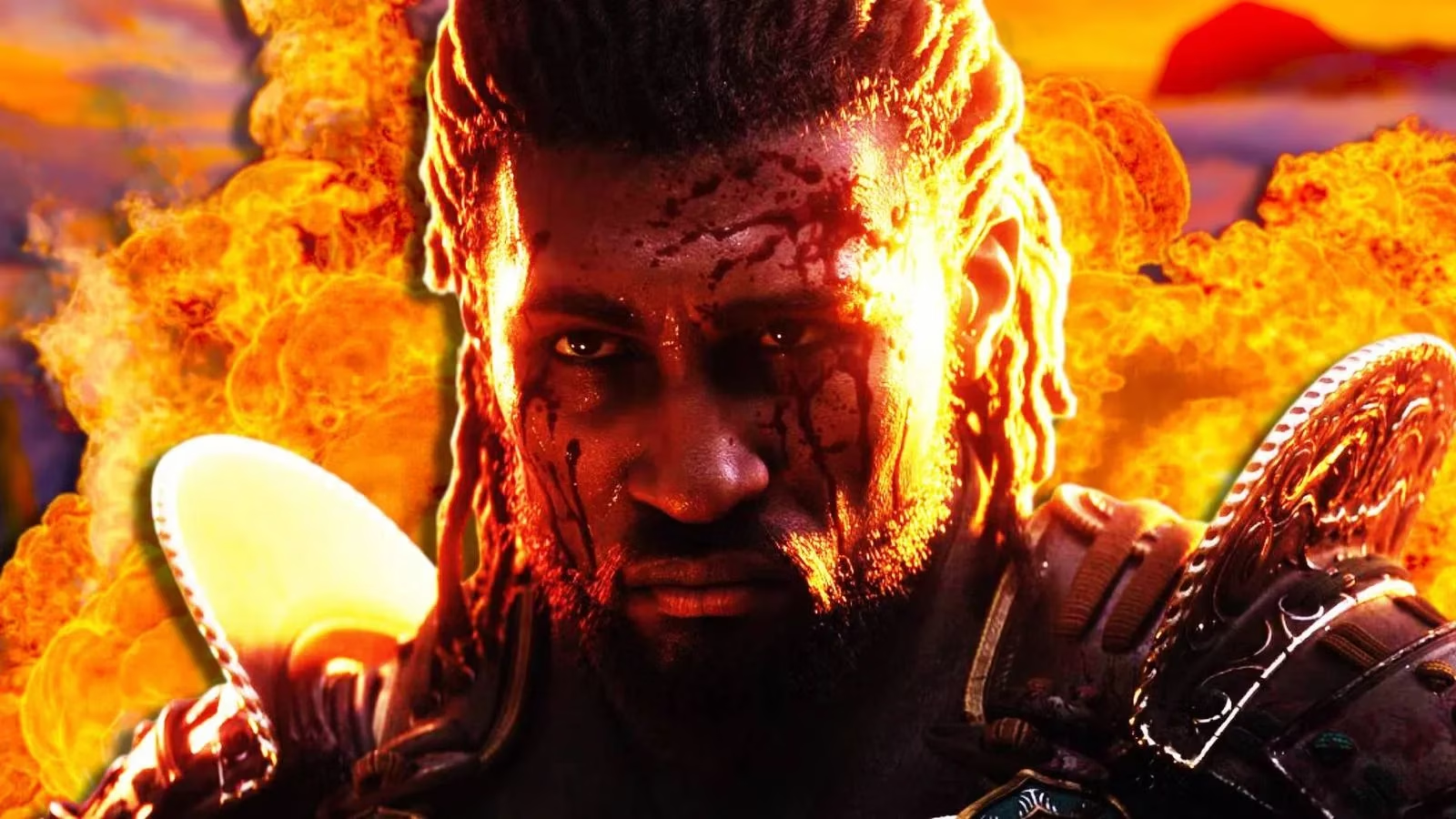
Surprisingly, it wasn't Yasuke's... let's say deliberate... movement that broke the camel's back. Playing as the hulking African samurai actually felt like a breath of fresh air when he was introduced, a perfect counterpoint to Naoe's nimble stealth. No, the exploration's fatal flaw was a double whammy of boredom and sameness.
-
The Journey is a Slog: The game does almost nothing to make the act of traveling interesting. Fast travel exists precisely because getting from point A to point B is so often tedious, but great games find ways to make the journey itself engaging. Shadows does not. Imagine if Naoe and Yasuke actually talked during those long horseback rides—bantering, sharing stories, reacting to the world. Instead, every trek is a lonely, silent affair. Your horse plods through the same scenery, past the same respawned bandits you've slaughtered a dozen times, toward an objective marker that never seems to get closer. The occasional random encounter? A repetitive distraction you'll soon learn to ignore entirely.
-
A World You Can't Touch: This is the real kicker. The world of Shadows is stunning to look at, but it's essentially a museum diorama. You can't meaningfully interact with it. Compare it to games where traversal is the mechanic, where the environment is a puzzle to be navigated or a story to be documented. Shadows has none of that. You have these cool parkour and climbing abilities, but they're only used to get over specific obstacles to reach the next combat arena or viewpoint. The world itself is just backdrop.
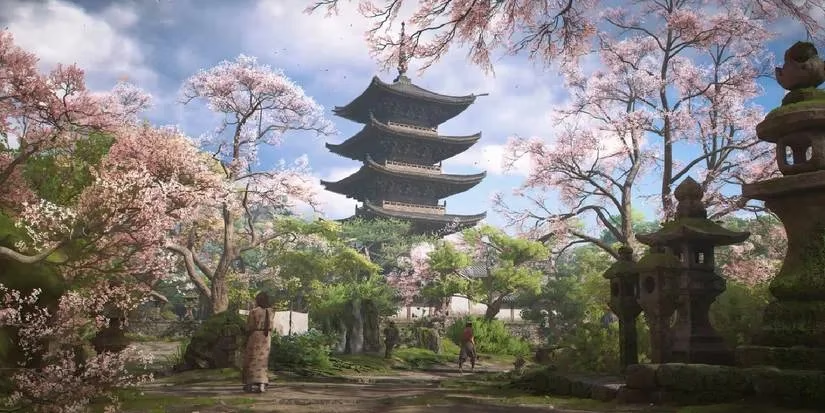
Speaking of backdrop, let's talk about the paint job—a very pretty, but monotonous one. The other major exploration sin is a crippling lack of visual variety. The dynamic seasons mechanic is technically impressive, sure. Watching snow blanket a forest or cherry blossoms bloom is lovely. But it's an illusion. It's the same landscape wearing different seasonal hats. 🎩🍂🌸☀️
The game's commitment to a more realistic tone than Ghost of Tsushima is admirable, but it comes at a cost. Tsushima had those breathtaking, impossible vistas—fields of vibrant flowers buttressed against forests of golden leaves. Shadows can't do that. Its realism means one region of forested mountains looks painfully similar to the next region of forested mountains. Unlocking a new area on the map generates not excitement, but a sigh. "Oh, more of this." There's no thrill of discovery, no satisfaction in revisiting a place because it all blends into a homogeneous, albeit beautiful, paste.
| Feature | Promise | Reality |
|---|---|---|
| World Design | Guided, intentional exploration | Funnels you into repetitive loops |
| Visual Variety | Four dynamic seasons! | Same landscapes with a filter change |
| Travel Mechanics | Dual protagonists with unique skills | Silent, lonely horse rides & respawning enemies |
| World Interaction | A living, breathing feudal Japan | A beautiful but static diorama |
In the end, the player was left with a realization as stark as a winter branch: many of these issues might have been solved if Shadows had used distinct open areas instead of one giant open world. Look at Star Wars Outlaws—by breaking its galaxy into separate, themed planets, it injected variety and kept exploration fresh. Ubisoft has the blueprint, but seems wedded to the single-map model.
So, here we are in 2026. Assassin's Creed Shadows is not a terrible game—far from it. There are moments of brilliance, of stealthy tension and cinematic clash. But its exploration, that core pillar of the open-world experience, is mechanically years behind its RPG peers and fails to sustain its own initial promise. It's a poignant lesson: you can dress up a familiar formula with brilliant settings and clever gimmicks, but if the heart of the journey is empty, even the most loyal fans will eventually find their love has... faded to shadow. 😔⚔️