When Assassin’s Creed Shadows launched in March 2025, few industry observers expected it to become Ubisoft’s saving grace. The game had been engulfed in controversy from the moment its protagonist was revealed. Yasuke, the African-born samurai who served under Oda Nobunaga, stirred heated debates online. Critics argued that featuring him as the lead character was a misrepresentation of feudal Japan, and many called for a boycott. Yet, one year later in 2026, the story has taken a sharp turn—one that even the most optimistic fans didn’t see coming.
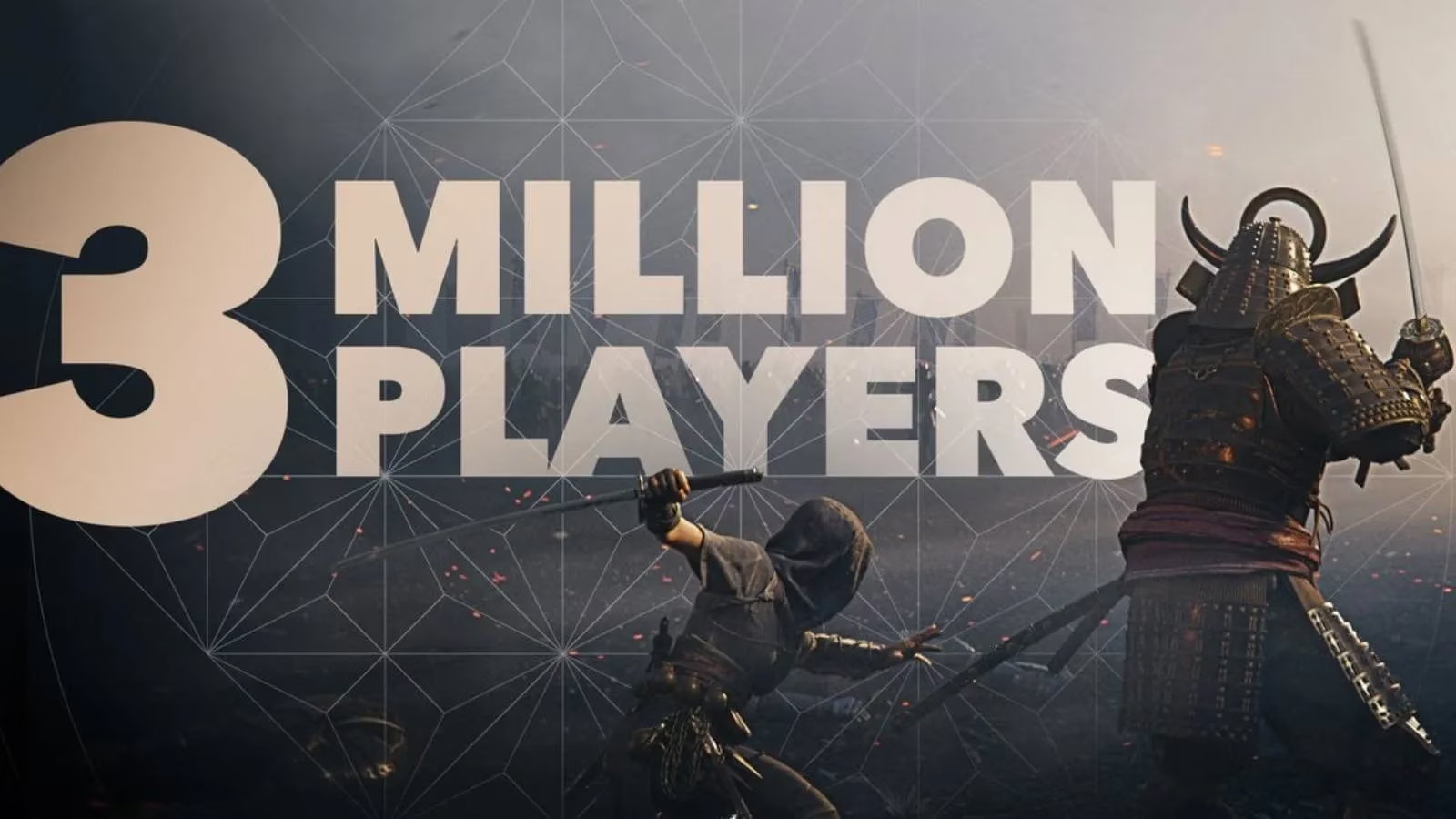
Within days of release, the game achieved a staggering milestone: three million players, marking the second-highest day-one sales revenue in the history of the Assassin’s Creed franchise. This was a much-needed win for Ubisoft, a company that had been struggling with financial stability and internal restructuring. The question on everyone’s mind was simple: could a game so mired in pre-launch negativity really pull the publisher back from the brink?
The controversy surrounding Yasuke was undeniably loud. Social media platforms were flooded with accusations of historical inaccuracy and ‘forced diversity.’ Some players vowed to skip the title entirely. But, paradoxically, the uproar generated an immense amount of curiosity. Gamers who might have ignored a standard Assassin’s Creed entry were suddenly intrigued. Why was everyone so upset? What was the real story behind the black samurai? This ‘negativity dividend’ turned out to be a powerful marketing force. As the saying goes, there’s no such thing as bad publicity.
Ubisoft executives watched the player count rise with a mix of relief and disbelief. Just a few months earlier, the company had entered a strategic partnership with Tencent, creating a dedicated subsidiary to manage its core franchises—Assassin’s Creed, Rainbow Six Siege, and Far Cry. The move was seen as a desperate bid to stabilize the sinking ship. The success of Shadows proved that the ship still had some wind in its sails. The three-million mark wasn’t just a vanity metric; it meant the game was rapidly approaching its break-even point, something that had seemed like a distant dream during the tumultuous development cycle.
Now, in 2026, the game continues to receive steady updates. New game modes, story expansions, and quality-of-life improvements have kept the player base engaged. The initial outcry has largely faded, replaced by a community that debates historical nuance rather than boycotting the product. Analysts point out that the launch numbers were only the beginning. Over the past year, Assassin’s Creed Shadows has quietly doubled its lifetime players, reaching over six million across all platforms. It’s not a record-shattering figure compared to free-to-play giants, but for a single-player premium title from a company on the ropes, it’s a remarkable turnaround.
So, was the controversy a blessing in disguise? From a numbers standpoint, it certainly helped. But long-term sustainability requires more than just viral outrage. Ubisoft seems to understand this. With Tencent’s backing, the studio has invested in deeper historical research and community engagement. Future expansions for Shadows have included optional educational content that clarifies Yasuke’s real historical role, blending entertainment with a degree of academic authenticity. This approach has won over some of the early critics. Could anyone have predicted that a debate over representation would morph into a genuine dialogue about history?
Looking ahead, the question is whether Ubisoft can replicate this formula with its other franchises. The dedicated subsidiary structure allows each brand to focus on its strengths. Rainbow Six Siege continues to thrive as an esport, and Far Cry rumors suggest a bold new direction. However, the road to redemption is long. A single success does not erase years of missteps. The company must maintain a cadence of quality releases and transparent communication. For now, though, Assassin’s Creed Shadows stands as proof that even in the most chaotic circumstances, a well-executed game can defy expectations. The black samurai who sparked a thousand arguments might just be the hero Ubisoft needed all along.