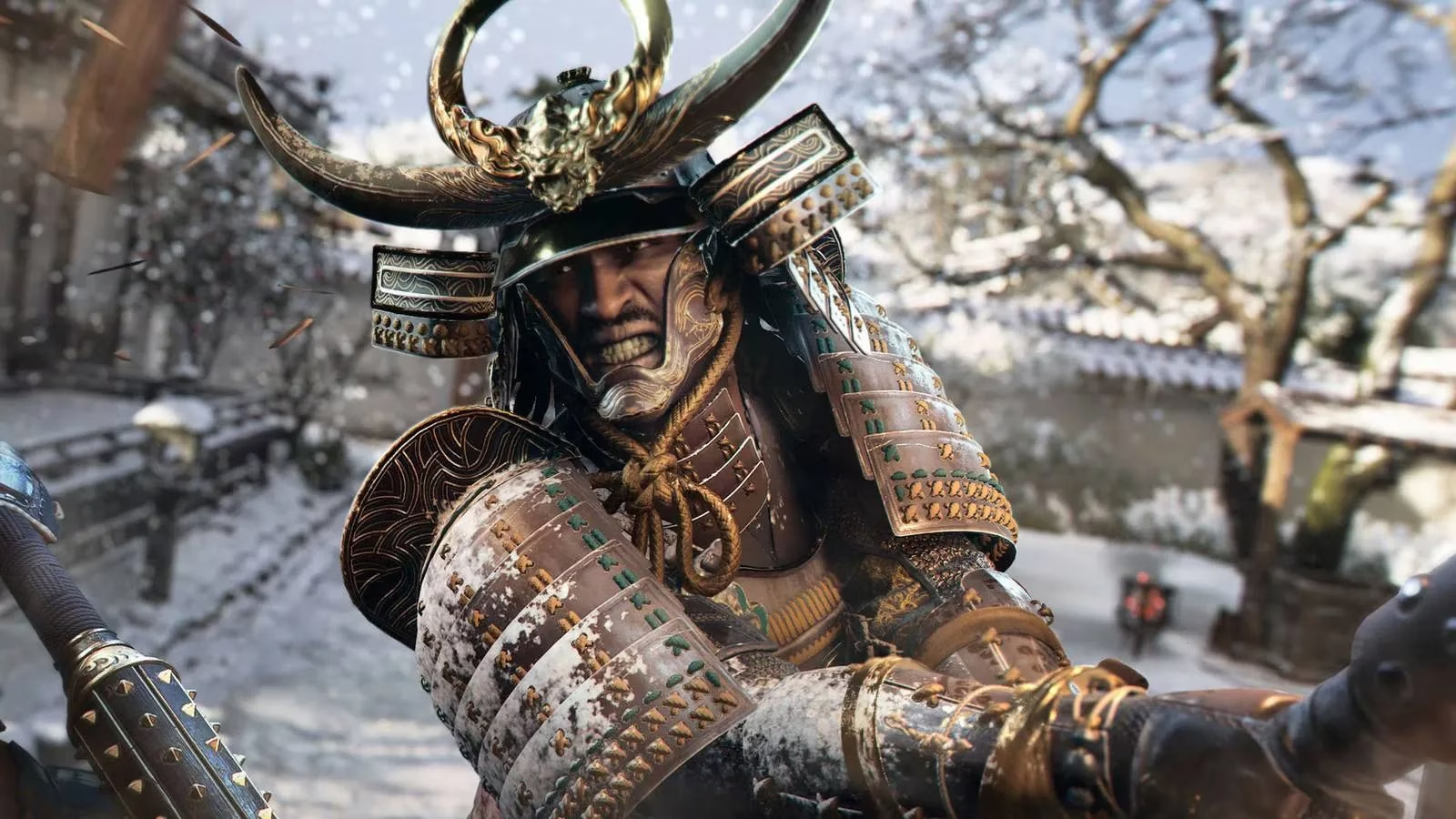
Ubisoft has kicked off its post-launch support for Assassin’s Creed Shadows with a focused hotfix designed to improve overall stability. The action-adventure blockbuster arrived on major platforms in late March 2025, transporting players to feudal Japan, where the African-born samurai Yasuke and the nimble shinobi Naoe navigate a sprawling open world shaped by the age-old clash between the Assassin Brotherhood and the Templar Order. Early reception praised the impressively rendered environments and the flexible gameplay loop, which lets players switch between Naoe’s stealth-focused assassin approach and Yasuke’s direct, strength-based combat style. Not every review was glowing, and some scores fell short of the series’ most admired entries, but Ubisoft Quebec is clearly committed to refining the experience through downloadable updates.
🔧 What’s Inside the First Assassin’s Creed Shadows Hotfix?
The first post-launch hotfix, released shortly after launch, may not overhaul the game, but it addresses a few frustrating technical problems. The patch is roughly 8.88GB, a sizable download for what appears to be a fairly short list of changes. Still, modern open-world titles often bundle platform-specific fixes and invisible systems tweaks under a single update, so the size is not unusual for a triple-A action game of this scale.
The official patch notes list three clear bullet points:
-
Stabilization: Fixed some global issues
-
[PS5] Fixed a Photo mode issue that could cause a crash when fetching photos to display on the world map
-
[PC] Fixed a Photo mode issue that could cause a crash when taking a photo
In plain terms, the hotfix tackles two separate Photo mode crashes. On PlayStation 5, the game could become unstable when a player attempted to fetch photos and display them on the world map. On PC, the issue occurred during the simple act of taking a photo. For a community that loves virtual photography and treats Photo mode as a core part of open-world exploration, these were meaningful fixes. The update also includes a general stabilization pass meant to address smaller global issues that can pop up across large interactive environments.
To put the platform-specific fixes in perspective:
| Platform | Reported Problem | Hotfix Fix |
|---|---|---|
| Global | Various smaller stability issues | General stabilization pass |
| PlayStation 5 | Photo mode could crash when fetching photos to show on the map | Dedicated crash fix |
| PC | Photo mode could crash when taking a photo | Dedicated crash fix |
📸 Photo Mode, Cultural Context, and Community Concerns
This first hotfix was not actually the first Assassin’s Creed Shadows update to arrive. Shortly before the game went live, Ubisoft quietly deployed a separate patch that removed the ability for players to damage shrines and temples within the game world. That change came after videos and discussions about destructive acts at in-game religious sites sparked a broader cultural sensitivity debate, with attention eventually reaching high government circles in Japan, including comments tied to the Prime Minister’s office. By restricting damage to sacred locations, Ubisoft aimed to show respect for Japanese heritage and real-world religious traditions while still preserving the fictional historical sandbox that fans expect from the franchise.
The dual-protagonist structure of Assassin’s Creed Shadows has been one of its most talked-about elements. Naoe offers a more traditional stealth experience, complete with hidden routes, rooftop traversal, and silent takedowns, while Yasuke leans into heavier weapons, direct confrontations, and a more forceful fighting style. This dual approach means that a technical issue like a Photo mode crash can affect two very different playstyles in the same way, since both character types can stop to document their journey through the game’s detailed feudal landscapes. Players often use captured images to share discoveries, track locations, and preserve memorable moments from their playthroughs, so Photo mode stability is more than a superficial concern.
🗡️ What Future Assassin’s Creed Shadows Updates Could Bring
Looking ahead, Assassin’s Creed Shadows is likely to receive further updates as Ubisoft follows the standard post-launch rhythm for major releases. Developers commonly use hotfixes to address immediate crashes and serious bugs, then follow up with larger patches that tune gameplay, improve performance, and add requested quality-of-life features. By 2026, the game has already moved through an expected update cycle, and support for open-world action titles often continues well beyond the launch window. Players can reasonably expect future patches to build on this early stabilization work, smoothing out rough edges in stealth, combat, parkour, and exploration while responding to community feedback.
For now, the first hotfix may feel modest, but it signals a steady commitment to polish. Assassin’s Creed Shadows earned strong player counts and solid engagement at launch, and keeping that momentum requires more than just impressive sales numbers. It demands a clean, stable experience across PlayStation 5, Xbox Series X/S, and PC. With Photo mode crashes addressed and global stability improved, players can return to hiding in shadows, scaling pagoda rooftops, and uncovering the secrets of a beautifully rendered feudal Japan without worrying about losing a perfect screenshot to a sudden crash. 🎮
Technical performance context is informed by Digital Foundry, whose detailed breakdowns of console and PC builds underline why early hotfixes like Assassin’s Creed Shadows’ Photo Mode crash fixes can be so important for maintaining stability across complex open worlds. With Ubisoft’s first patch focusing on PS5 map-photo fetching crashes and PC capture crashes, it reflects a common post-launch pattern: prioritize reproducible stability failures first, then iterate toward broader performance tuning and quality-of-life improvements in subsequent updates.