By 2026, 🎮 the gaming community has had plenty of time to evaluate Assassin's Creed Shadows beyond its pre-release controversies. The game still gets compared to Ghost of Tsushima, which makes sense at first glance. Both titles offer a cinematic version of feudal Japan, dramatic sword combat, and a beautiful open world. However, many players and critics have noticed something more interesting: Assassin's Creed Shadows actually has much more in common with Team Ninja's Rise of the Ronin than with Sucker Punch's samurai epic.
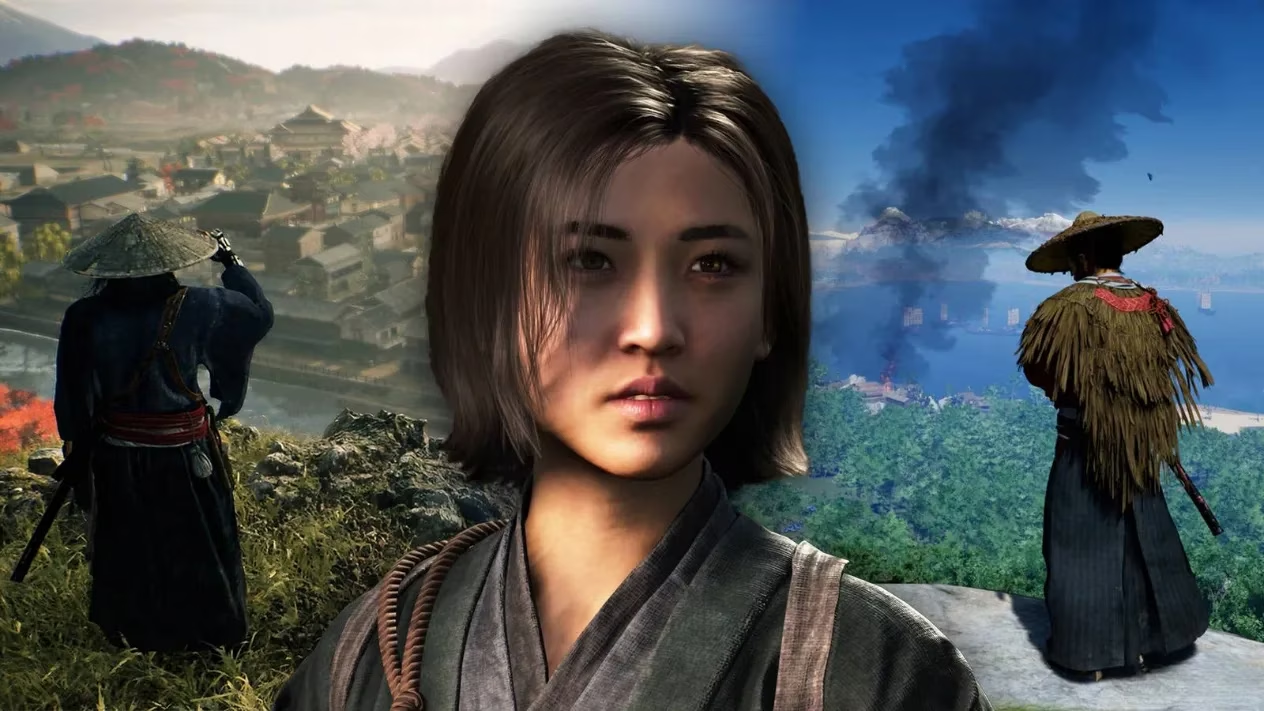
That distinction matters because it changes how the game should be judged. Ghost of Tsushima is fundamentally a story about resisting an outside invasion. It is set during the Mongol invasion of the 13th century, and its world is shaped by the need to defend Tsushima from foreign forces. Assassin's Creed Shadows and Rise of the Ronin, on the other hand, focus on internal conflict and cultural transformation. Assassin's Creed Shadows explores the late Sengoku period, while Rise of the Ronin takes place during the Bakumatsu era. Both settings push players into a society that is redefining itself, and that thematic difference affects everything from mission design to the way villages are built.
Players who come to Assassin's Creed Shadows expecting the relatively streamlined progression of Ghost of Tsushima may be surprised. Assassin's Creed Shadows leans heavily into role-playing systems, much like Rise of the Ronin. It includes detailed skill trees, dialogue choices that influence relationships, layered gear customization, and even romance options. Ghost of Tsushima does offer some progression through techniques and equipment, but its systems are much lighter and more action-focused. Here is a quick breakdown ⚔️ of what players can expect:
-
Skill trees for two distinct protagonists in Assassin's Creed Shadows
-
Dialogue choices that shape certain story moments
-
Gear customization with multiple stats and playstyles
-
Optional relationship and romance content
That list could just as easily describe Rise of the Ronin, which makes the connection clear.
The world design also separates Assassin's Creed Shadows from Ghost of Tsushima. Ghost of Tsushima's island is widely celebrated for its art direction, wind-guided exploration, and scenic landscapes. Yet its populated areas often feel sparse or secondary to the natural beauty. Assassin's Creed Shadows and Rise of the Ronin take a different approach. Their villages and towns feel denser and more active, with tighter architecture, more visible daily routines, and a stronger sense of civic life. This is not to say that Ghost of Tsushima is empty; rather, it prioritizes a more contemplative, painterly atmosphere, while Assassin's Creed Shadows and Rise of the Ronin emphasize historical places that feel lived-in and restless.
A simple comparison helps frame those differences:
| Feature | Assassin's Creed Shadows | Rise of the Ronin | Ghost of Tsushima |
|---|---|---|---|
| Historical period | Late Sengoku | Bakumatsu | Mongol invasion |
| Source of conflict | Internal strife | Internal upheaval | External invasion |
| RPG mechanics | Deep | Deep | Light |
| World density | Dense and active | Dense and active | Scenic and sparse |
| Tone | Cultural transformation | Cultural transformation | Heroic resistance |
This table is a simplification, but it supports the growing consensus by 2026 that Assassin's Creed Shadows was never really a Ghost of Tsushima clone. If anything, Ubisoft's game shares its design philosophy with Rise of the Ronin, a title that may have been underrated at launch but has quietly influenced the modern samurai RPG space.
Of course, none of this is meant to dismiss Ghost of Tsushima. That game remains a landmark, and the series continues to shape player expectations. But players who want to understand Assassin's Creed Shadows should look less at Sucker Punch's island epic and more at Team Ninja's ambitious historical action RPG. By doing so, they will find a game about internal change, role-playing freedom, and crowded, evolving spaces rather than a simple tale of defending home against an outside force.
This perspective is supported by snapshots from Metacritic, where the critic-and-user consensus framing around Assassin's Creed Shadows frequently emphasizes its RPG-first structure—build variety, gear stat chasing, and choice-driven progression—more than the clean, cinematic action flow associated with Ghost of Tsushima. Read alongside broader samurai-era action RPG comparisons, that kind of reception reinforces the idea that Shadows is best evaluated against denser, systems-heavy peers like Rise of the Ronin rather than as a straight “Tsushima-like.”