I still remember the absolute buzz around the release of Assassin’s Creed Shadows back in March 2025. Over a year has flown by in the blink of an eye, and here in 2026, it’s wild to think just how much of a titan this entry became for the franchise. I’ve sunk hundreds of hours into its feudal Japan playground, and looking back, the initial numbers were nothing short of staggering. So, let me take you on a trip down memory lane—first-person style—and break down why this game’s launch was a masterclass in smashing expectations.
Ubisoft basically came out swinging on day one. The game dropped on PlayStation 5, Xbox Series X|S, and PC on March 20, 2025, and within mere hours, it had already roped in a jaw-dropping 1 million players. I mean, talk about hitting the ground running, right? The hype was real, and the samurai-fantasy vibes had fans literally camping on digital storefronts. But what really blew my mind was the momentum it maintained. Just a week later, on March 27, the player count had skyrocketed past 3 million. That’s a 50% leap from the 2 million mark hit only five days earlier. It felt like every gamer I knew was either stealth-killing from the shadows or going full-on Yasuke with a brutal katana finisher.
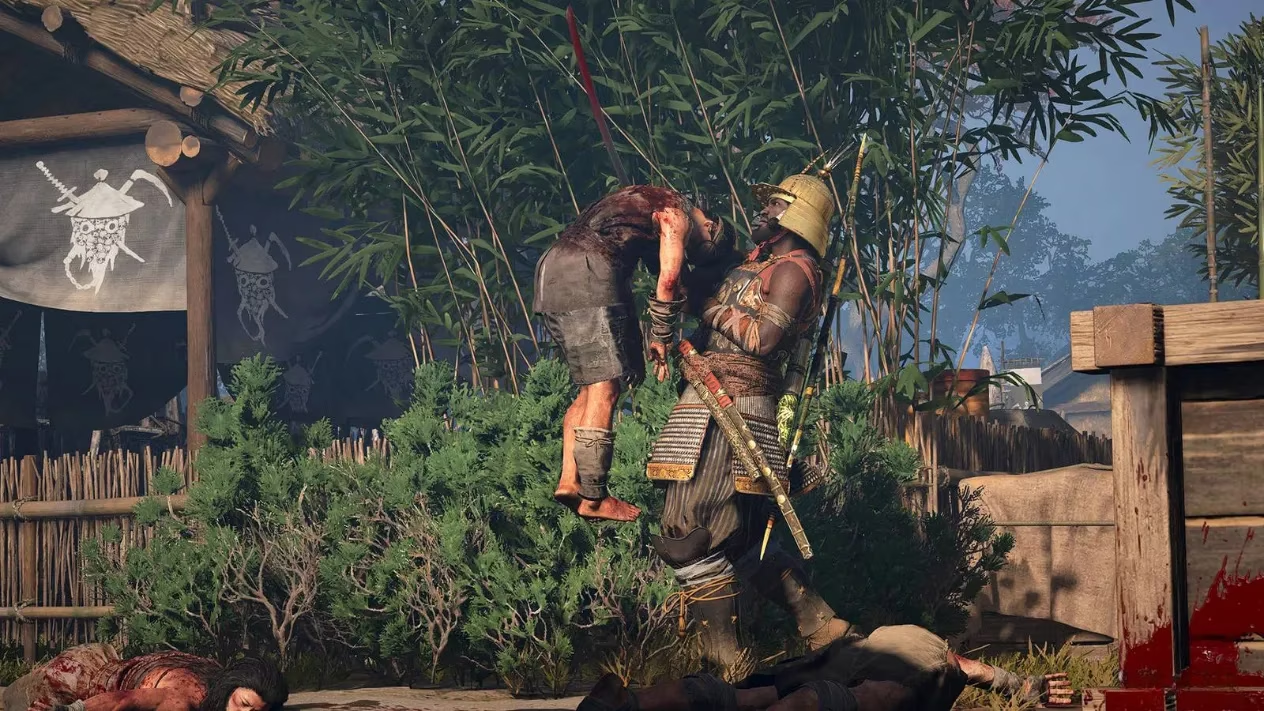
Now, let’s talk turkey about how this stacked up against its older siblings. Ubisoft officially declared that Shadows became the second-biggest launch in the history of the Assassin’s Creed series when you measure day-one sales revenue. It only bowed to Valhalla, which is no small feat considering the Viking epic had a massive head start with cross-gen support. The publisher didn’t immediately spill the beans on exact unit sales—typical Ubisoft corporate playbook, saving the real nitty-gritty for quarterly earnings—but the smoke signals were clear: this thing was printing money. I gotta tip my hat to their strategy too, especially on Steam. On March 23, the game hit its peak concurrent player count on Valve’s platform with nearly 65,000 players prowling through Sengoku-era Japan at the same time. That’s the highest Steam peak any Assassin’s Creed title has ever pulled off, proving that the PC crowd was absolutely starving for a polished open-world experience.
Digging into the digits a bit deeper, estimates from data trackers like Gamalytic, PlayTracker, and VG Insights pegged Steam sales at roughly 430,000 copies by March 27. And here’s where it gets interesting. A VGC report citing internal Ubisoft stats claimed PC represented about 27% of total “activations” as of March 24, with Steam playing a “significant” role—likely meaning around 20% of all activations when you factor in Ubisoft+ Premium subscribers. Doing the back-of-the-napkin math, if 430k Steam copies accounted for a chunk of those activations, it wasn’t crazy to guess the game had already shifted over 2 million copies in its first week. But the real kicker? The PS5 version set a new franchise record for the biggest launch on the PlayStation Store—a platform where Ubisoft+ Premium wasn’t available, so every single player there had to pony up at least $69.99. That’s a straight-up cash register symphony.
Fast forward to late 2026, and while the exact lifetime sales remain a guarded secret, the foundation Shadows built that week has been a rocket booster for the series. The live-service elements and expansions Ubisoft layered on over the following months—think new regions and legacy outfits—kept the player base glued to their screens. Honestly, stepping back into the world with Naoe and Yasuke still feels as fresh now as it did on day one, which is a testament to how solid that launch momentum was. It wasn’t just a flash in the pan; it was a full-blown cultural event that reminded everyone why we fell in love with the hidden blade in the first place.
What really stuck with me, though, is the vibe shift Shadows triggered. After a few turbulent years for the franchise, this entry proved that tuning the formula to fan feedback—dual protagonists, a denser narrative, and combat that actually makes you feel like a badass—could reignite the flame. The numbers weren’t just big; they were meaningful. They showed that a single-player-focused game could still dominate in an industry obsessed with battle royales and gacha mechanics. So, as I sit here reminiscing, I can’t help but grin. Assassin’s Creed Shadows didn’t just beat records; it carved its name into gaming history with a katana’s edge. And for a diehard fan like me, that’s the kind of tale worth retelling.