The world of Assassin's Creed Shadows in 2026 is a landscape of quiet dissonance. The feudal Japan it so painstakingly renders, with its mist-shrouded valleys and imposing castles, feels at odds with the persistent, digital whispers of a modern marketplace. Weekly quests flicker on the map like phantom lanterns, beckoning the solitary player to seal Animus rifts, tasks that feel as ephemeral as cherry blossoms in a storm. These are not the profound, narrative-driven side quests of old, but checklist chores, their value measured not in story but in mid-tier gear and menu-locked lore, conveniently adjacent to the ever-present store. It is a system that asks the player to linger in a world long after its story has been told, a lonely vigil in an exhausted realm where the only company is the ghost of a transaction yet to be made.
The fundamental tension lies in the grafting of live-service mechanics onto a single-player frame. Multiplayer titles thrive on the constant churn of a community, the shared struggle and camaraderie that justifies weekly rituals. Here, the incentive is hollow. 😕 The quests repeat, the gear becomes obsolete upon the story's climax, and the player is left to wander a beautiful but empty diorama. The architecture of the game world, designed for solitary exploration, groans under the weight of systems meant for a crowd. It feels like being asked to attend a grand, silent banquet alone, with a waiter constantly suggesting you might like to purchase a slightly shinier fork.
This pervasive sense of isolation is rendered all the more poignant by the game's own, brilliant foundation. Shadows is built upon a duo of protagonists who are not mere cosmetic choices but distinct, complementary souls.
-
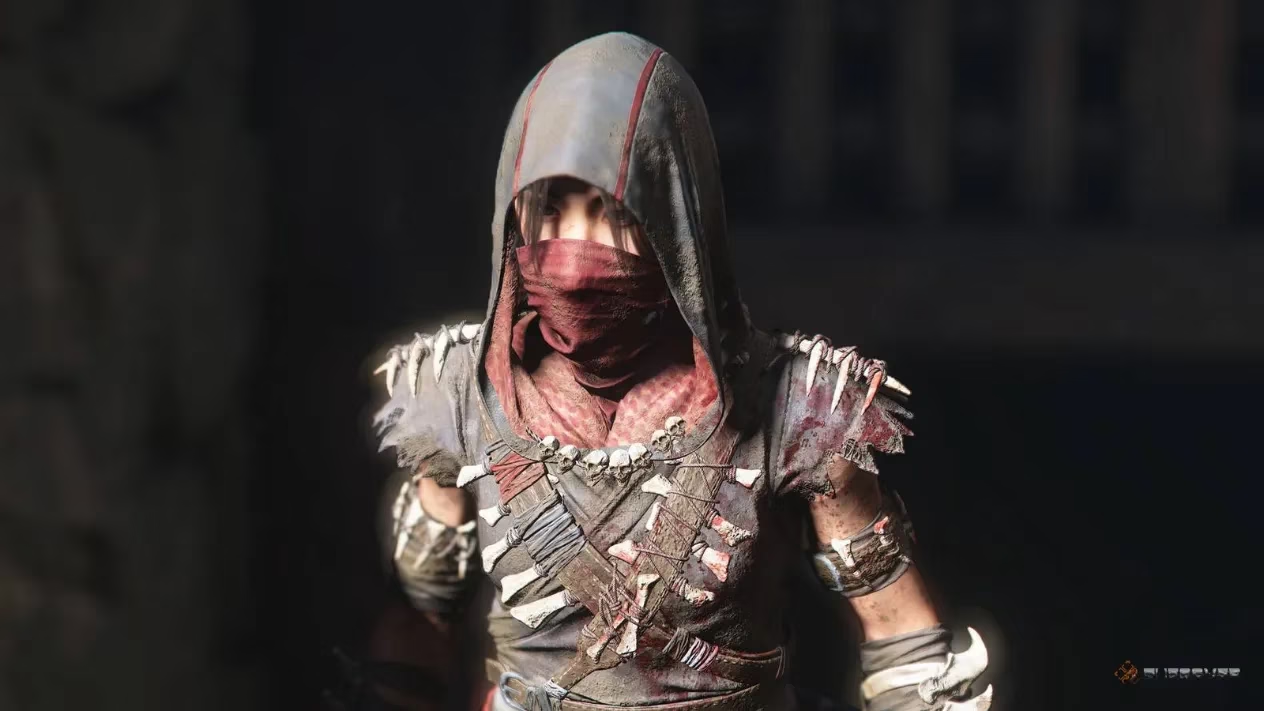
Naoe, the agile shinobi, is a whisper on the wind. Her strengths are stealth, parkour, and precision, but she is fragile, unable to move the heaviest obstacles.
-
Yasuke, the stalwart samurai, is a thunderclap. He is strength and resilience incarnate, carving through battalions, but his movements are less graceful, his approach more direct.
The game's design insists you switch between them, creating a rhythmic dance of playstyles. Yet, in practice, this dance often stumbles into clumsy, inorganic pauses. A player might infiltrate a fortress's outer walls with Naoe's ethereal grace, only to confront a massive barricade that only Yasuke's brawn can shift. The solution? Retreat, swap characters in a menu, charge back in, solve the obstacle, and then swap again. It breaks the immersion, turning a dynamic partnership into a logistical chore.
This is where the missed opportunity screams loudest. The narrative shows us a partnership—Yasuke creating a diversion at the main gate while Naoe scales the inner walls, their fates intertwined in cutscenes. But the gameplay forces a separation. One character vanishes into the ether when the other is chosen, creating a narrative-gameplay schism. The potential for genuine, emergent co-operative play is not just a fan's wish; it is a logic embedded in the game's very DNA.
Imagine the harmony that could be: 🎌
| Solo Play Experience | Potential Co-op Symphony |
|---|---|
| Awkward character swapping at barriers | Yasuke holds the line while Naoe slips through a secret passage. |
| Reaching a vantage point only one can climb | Naoe ascends to drop a rope for Yasuke, or scouts the path ahead. |
| The other protagonist "disappearing" during missions | Constant communication, covering each other's weaknesses, sharing the moment of triumph. |
| Narrative bonding only in cutscenes | Bonding forged in the heat of shared, unscripted gameplay. |
Co-op would transform these mechanical necessities into moments of strategic collaboration and character bonding. It would make the world feel alive with a shared purpose, rather than a lonely stage for repetitive tasks. The much-maligned battle pass and weekly quests would still feel like foreign implants, but their presence might be easier to tolerate if they were challenges undertaken with a companion, a shared goal in a world built for two.
As of 2026, Assassin's Creed Shadows stands at a crossroads. It possesses the perfect ingredients—dual protagonists with symbiotic skills, a world rich with verticality and tactical opportunities—to be a landmark co-operative experience. Instead, it asks the player to embody both halves of a whole, alone. The leap of faith is not across a rooftop, but towards a design philosophy that embraces the partnership it so eloquently preaches. Until then, players navigate its beautiful, conflicted world, one silent, solitary swap at a time, forever feeling the ghost of a companion who should be by their side.